Brainstorm Test: Tricky Puzzle
- 4.1
- Rating
- 1.00M
- Installs
- Free
- Price

 Analysis by App-foxy
I found Brainstorm Test: Tricky Puzzle most interesting as a quick shared-device game rather than a title that demands a long, uninterrupted session. It is a free trivia game from Tribom Games, built around puzzles that try to make you question your first answer. That simple idea works especially well when two people are looking at the same screen: one person spots the obvious solution, the other notices the wording that changes everything.
After spending time with it, my main impression is that the game succeeds when you treat each puzzle as a small conversation. It is not just about knowing facts or tapping quickly. The enjoyable part is slowing down enough to inspect the question, challenge your assumptions, and explain why an answer makes sense. That makes it a useful choice for a short break, a waiting room, or a relaxed moment at home when someone else wants to join in without learning a complicated control scheme.
How Brainstorm Test works on a shared device
The best household scenario is simple: one person holds the phone while another reads the puzzle aloud or watches the choices. You can answer independently, compare guesses, and then discuss the wording before moving on. Because the game belongs to the trivia and puzzle space, it is easy for a casual player to understand immediately, even if they rarely play mobile games.
You May Also Like

 Blood Strike: 2.5 Anniversary
Blood Strike’s Loadouts Turn Every Drop Into a Tactical Gamble
A close look at Blood Strike’s custom loadouts: how fast access to signature weapons reshapes its battle royale rhythm, rewards preparation, and narrows the gap between fights.

 Pandora - Music & Podcasts
Pandora’s Music Is Easy to Start, but Harder to Recover
Pandora’s strength is its low-effort path from a seed to a station. Its weak spot is how much confidence it asks you to place in connection, setup, and quiet recovery.

 8 Ball Pool
 Is Built on Rivalries, Rematches, and Routine
A close look at the rivalries, rematches, shared routines, and unanswered safety questions that turn a quick pool match into a persistent mobile community.

 Samsung Music
’s Quiet Strength Is Playing What You Already Own
Its reach comes less from spectacle than from dependable access to a personal library. That simplicity is both the app’s strongest retention engine and its ceiling.

 AccuWeather: Weather Radar
AccuWeather Review: A Quick, Clear Forecast for Everyday Decisions
For everyday plans, the best forecast is the one you can understand quickly. AccuWeather makes rain timing, radar, and local conditions easy to act on, with a few trade-offs.

 Hill Climb Racing
Why Hill Climb Racing Still Turns Crashes Into One More Run
A tiny car, a bumpy hill and one more upgrade: Hill Climb Racing keeps resurfacing because its simple chaos makes every near-miss feel personal.
More From Our News Desk



I especially like this format for short bursts between ordinary tasks. A parent waiting while dinner finishes, roommates taking a break, or friends passing one phone around can all get something from it without committing to a full match. The game encourages a “think twice” rhythm, so the person who answers fastest is not automatically the person who performs best.
That shared use also reveals one of its limitations. The experience is fundamentally centered on the device in front of you, so it does not replace a dedicated multiplayer trivia platform where every participant has a separate screen, profile, or clearly tracked score. If your household wants formal competition, private rankings, or a structured party mode, a conventional multiplayer alternative may be a better fit. Brainstorm Test is stronger as an informal challenge than as a complete social game.
Why the puzzle wording matters
The tricky-question format rewards a different habit from ordinary quiz apps. In a standard trivia game, I usually rely on recall: identify the subject, retrieve the answer, and move on. Here, I get better results by treating every word as deliberate. A question that looks familiar may be testing interpretation rather than knowledge, which makes reading carefully more valuable than tapping quickly.
My practical tip is to pause before choosing an answer, then ask myself what the question is actually requesting. When playing with someone else, I would have each person explain their reasoning before either player touches the screen. That turns a wrong answer into a useful discussion instead of a frustrating mistake. It also prevents the more confident player from deciding for everyone too early.
Another useful approach is to separate “I know this” from “this sounds right.” Those feelings are easy to confuse in a puzzle game designed around misleading assumptions. I found that saying the answer aloud often exposed a gap in my reasoning. On a shared phone, this creates a natural turn-taking routine: one person proposes an answer, the other acts as the skeptic, and both agree before continuing.
What to expect before installing
Brainstorm Test is free to install, which makes it easy to try on a household phone without making a purchase decision first. The game is marked for Everyone, so its basic presentation is suitable for a broad age range. Still, an age label does not mean every puzzle will feel equally easy or equally interesting to every player. Younger children may enjoy guessing and the surprise of a trick, while older players may care more about whether the wording feels clever rather than merely confusing.
The current version is 1.1.22 and it requires Android 8.1 or later. That requirement is worth checking before handing the game to an older spare device. A phone that is rarely updated may be perfectly usable for other tasks but still fail the installation requirement. In a shared household, I would check the device first rather than assuming that a free game will run everywhere.
There are in-app purchases ranging from $1.99 to $29.99 per item. I would keep that in mind if children use the phone or tablet, especially when the device is connected to a payment method. The game can be approached as a free download, but “free to install” and “no possible spending” are not the same thing. A sensible household routine is to let the device owner handle any purchase decisions and avoid treating an in-game prompt as part of the puzzle itself.
I also would not create a shared expectation that every player has the same progress or experience. The available details point to a game played on a device, not to a family-management system with separate child spaces or household profiles. That means the safest boundary is practical: decide who uses the device, who is allowed to make purchases, and whether the game is for cooperative guessing or informal competition. Those rules come from the household, not from assumptions about the app.
Coordinating turns without making it complicated
For two players, alternating the role of “reader” and “answerer” works well. The reader can cover the answer choices until the other person has considered the question, then reveal them. This small adjustment makes the session feel less like one person is simply watching another play. It also reduces the advantage of the person who happens to be holding the phone.
With three or more people, I would use a verbal round. Everyone gives an answer before the device owner selects one, and the group can keep its own informal tally on paper or in conversation. I prefer this to letting the quickest speaker dominate. It preserves the game’s central challenge—thinking carefully—without requiring features that are not part of the experience.
There is a trade-off here. Keeping scores manually can make a living-room session more engaging, but it also adds work. If you want automatic tracking, individual accounts, or a persistent competitive ladder, this is probably not the right tool. If you want a low-pressure prompt for conversation, the lack of formal structure can actually be helpful because nobody has to manage a lobby, invite code, or complicated match setup.
On a shared tablet, I would position the screen where everyone can read it and agree that nobody answers silently before the group has had a chance to think. This is a small but important distinction: the game’s value comes from interpretation, and coordination protects that value. It also makes the experience friendlier for a player who needs more time or is less comfortable with trivia.
Where it fits among ordinary trivia alternatives
Compared with a general knowledge quiz, Brainstorm Test places more weight on wording and misdirection. A conventional quiz is often satisfying because it confirms what you already know. This game is more satisfying when it catches you making a reasonable but careless assumption. I would choose the conventional option for studying facts, practicing a subject, or measuring knowledge in a straightforward way. I would choose this one when I want a mental reset that feels playful and slightly mischievous.
It also differs from fast-answer quiz games. Speed is not the only thing that matters here, and rushing can actively work against you. That makes it a better match for players who enjoy discussing possibilities, but a weaker match for anyone looking for rapid-fire action, timed pressure, or a polished tournament atmosphere.
Against a full puzzle adventure, the appeal is convenience. You can pick it up without learning a map, inventory system, or story background. The cost of that convenience is depth: the experience is organized around individual brain teasers rather than a larger world or sustained narrative. I would not use it as a replacement for a story-driven puzzle game, but I would happily keep it available for the moments when I only have a few minutes.
The store summary describes well-designed tricky puzzles, and that is the right expectation to carry in. I would not download it expecting a course, a reference tool, or a serious test of academic knowledge. Its purpose is lighter: make you pause, make you reconsider, and give you a small sense of satisfaction when the wording finally clicks.
Age, trust, and the role of the adult
The Everyone content rating makes the game approachable for mixed-age use, but shared play still benefits from adult judgment. A child may understand the puzzle but not the difference between a free installation and an optional paid item. I would let younger players participate while keeping purchase decisions with the device owner. That boundary is more important than trying to turn the game into a supervised lesson.
For older children and teenagers, the game can be a nice way to practice careful reading without feeling like homework. I would frame it as a challenge rather than a test of intelligence. Tricky questions are designed to produce mistakes, and a player who misses one should be encouraged to explain what led them there. That keeps the tone constructive and avoids turning a casual game into an argument over who is “smart.”
Adults may enjoy the same puzzles for a different reason. After a long day, I often prefer something that asks for attention but does not require emotional investment. A short session can be enough to interrupt repetitive scrolling. The game is also easy to hand to a visitor or family member because its premise is immediately understandable.
Trust matters in another way: players should agree not to search for answers while someone else is still thinking. Looking things up would undermine the point, especially when the challenge depends on noticing a detail rather than retrieving obscure information. In a household setting, an honor system is enough. The game works best when the group accepts that wrong answers are part of the entertainment.
Small tactics that improve the experience
My first tactic is to read the complete question twice, but with different goals. The first reading gives me the general meaning; the second makes me inspect qualifiers, unusual wording, and what the question leaves out. This is more effective than immediately scanning the answer buttons, which can anchor me to the first plausible option.
My second tactic is to ask for a counterargument. If I think an answer is obvious, I try to state why another answer might be tempting. That sounds minor, but it exposes the exact trap the puzzle may be using. In a group, this also gives quieter players a clear invitation to contribute.
My third tactic is to stop a session before everyone becomes irritated. Because the game is built from individual puzzles, it is easy to keep playing after the fun has faded, especially when a difficult question feels like something that must be defeated immediately. I get more from it when I treat a few puzzles as a complete break and return later with a fresh mind.
A fourth practical point concerns device sharing. If the phone belongs to someone who needs it for messages, navigation, or work, I would avoid turning the session into an open-ended pass-and-play event. Agree on a short round first. This keeps the game from becoming a source of friction and makes it easier for the owner to reclaim the device without interrupting a long competition.
Performance expectations and everyday fit
The game has passed the point of being a niche experiment: it has more than half a million installs and holds an average rating of 4.5 from roughly twelve thousand ratings. Those figures suggest that its basic concept has found a substantial audience, but they do not guarantee that every puzzle will suit every player. A person who dislikes trick questions may still find the central design irritating, even if the broader audience enjoys it.
I would judge it by the kind of attention it asks for. It is a good fit for someone who likes wordplay, lateral thinking, and the moment when an apparently simple question reveals a catch. It is less suitable for someone who wants predictable rules, direct factual questions, or a reliable way to improve knowledge in one subject.
The developer, Tribom Games, has positioned the game around accessible brain challenges rather than a complicated gaming system. That focus is helpful for shared use because there is little social pressure to perform a setup ritual before starting. At the same time, players who expect extensive customization or a deep progression structure should keep their expectations modest.
I also see a difference between playing alone and playing with others. Alone, the game becomes a compact test of patience and observation. With another person, it becomes a debate about interpretation. The second version is more distinctive to me, because the puzzles create conversation that a regular solo quiz often does not. If you only want private score chasing, its advantage is smaller.
My household verdict
I would recommend Brainstorm Test: Tricky Puzzle for households that want a free, approachable game to share casually, especially when the players enjoy explaining their reasoning. It is easy to understand, suitable for a broad age range, and more thoughtful than a quiz that rewards only instant recall. The strongest use case is a short cooperative or lightly competitive session around one screen.
I would skip it if your priority is a full multiplayer experience, formal family profiles, subject-based learning, or a story with long-term progression. I would also be cautious about handing the device to a child without first agreeing on purchase boundaries, since optional items can cost money even though the game itself is free to install.
For me, the deciding question is whether you enjoy being tricked in a fair way. When the wording feels clever, the game delivers a satisfying little mental jolt. When a puzzle feels more confusing than insightful, the same design can become tiring. That unevenness is the main trade-off, but it is also what separates this title from an ordinary trivia list.
Overall, I see it as a useful addition to a shared phone or tablet: not a replacement for a dedicated party game, and not a serious study tool, but a compact source of conversation and careful thinking. If you set clear device and purchase boundaries, invite everyone to reason before answering, and keep sessions short, it can turn a few spare minutes into a genuinely enjoyable household challenge.
FAQs for Brainstorm Test: Tricky Puzzle
01What is Brainstorm Test: Tricky Puzzle?
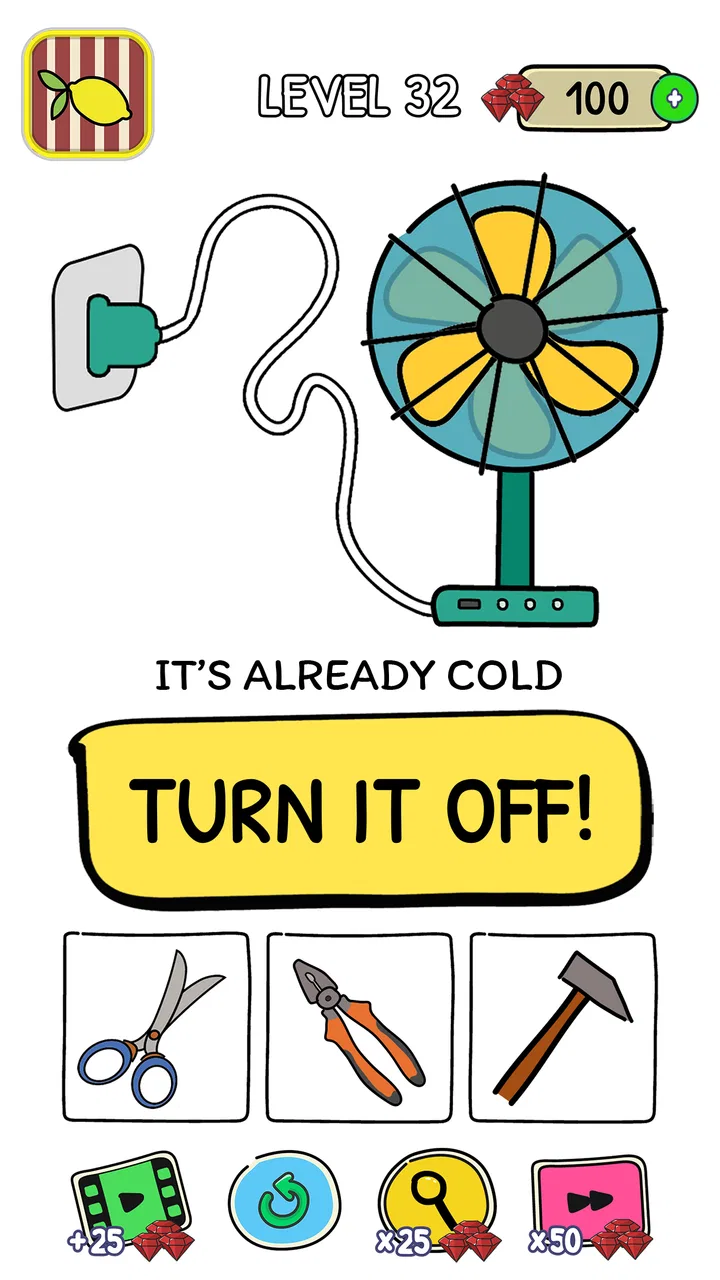
Brainstorm Test: Tricky Puzzle is a brain-teasing mobile game designed to challenge your critical thinking and problem-solving skills. It features a series of unconventional puzzles that require creative approaches to solve. With its engaging graphics and interactive gameplay, it offers hours of mental exercise and fun.
02Is Brainstorm Test: Tricky Puzzle free to play?
Yes, Brainstorm Test: Tricky Puzzle is free to download and play. However, it includes optional in-app purchases that can enhance the gaming experience. These purchases might offer hints, remove ads, or unlock additional levels, but they are not necessary to enjoy the full game.
03What age group is suitable for Brainstorm Test: Tricky Puzzle?
Brainstorm Test: Tricky Puzzle is suitable for players aged 12 and up. The game's puzzles range in difficulty and complexity, making it challenging yet accessible for teenagers and adults. Younger players might find some puzzles particularly difficult without assistance or guidance.
04Does Brainstorm Test: Tricky Puzzle require an internet connection?
No, Brainstorm Test: Tricky Puzzle does not require a constant internet connection to play. You can enjoy most of its features offline. However, certain elements, such as updates or in-app purchases, will require an internet connection to access.
05How often are new puzzles added to Brainstorm Test: Tricky Puzzle?
The developers of Brainstorm Test: Tricky Puzzle frequently update the game with new puzzles and challenges to keep the content fresh and engaging. Updates typically occur monthly, bringing new levels, features, and bug fixes to enhance the overall user experience.
Pros
- Engaging puzzles enhance critical thinking.
- Vibrant graphics make gameplay enjoyable.
- Regular updates with new challenging levels.
- User-friendly interface for easy navigation.
- Hints available to help when stuck.
Cons
- Ads can be intrusive during gameplay.
- Some puzzles are repeated frequently.
- In-app purchases can get expensive.
- Requires internet connection to play.
- Limited language options for instructions.

Brainstorm Test: Tricky Puzzle
Gallery